
Why Insulating Your Pipes Is Critical In The High Desert
The High Desert sits between roughly 2,000 and 6,000 feet of elevation, and that altitude changes everything about how a plumbing system behaves once the calendar turns toward winter. Homes in Phelan, Pinon Hills, Oak Hills, Hesperia, Victorville, and Wrightwood routinely see afternoon highs in the sixties followed by overnight lows in the twenties, and that swing of thirty or forty degrees in a single night puts stress on water lines that coastal homes never experience. Uninsulated pipes running through an unheated garage, a vented crawl space, an open attic, or along an exterior wall lose heat quickly once the sun goes down. When the water inside those lines drops to freezing and stays there for several hours, ice forms, pressure builds, and a copper or PEX line can split without any warning. September and October are the correct months to handle this work, because the first hard freeze in this region often shows up in November and nobody wants to discover a bare pipe at two in the morning on Thanksgiving. Pipe insulation is inexpensive, it installs quickly, and it protects both the water lines themselves and everything the water would ruin on its way to the floor. This guide covers what insulation actually does, where High Desert homes need it most, how to install it correctly, and when the job calls for a licensed plumber.
What Pipe Insulation Does For High Desert Homes
Pipe insulation is a sleeve of closed cell foam, fiberglass, or rubber that wraps a water line and slows the transfer of heat between the pipe and the surrounding air. That single function delivers two separate benefits in a climate like ours, and homeowners tend to only think about one of them. In winter, insulation slows how fast the water inside a line loses heat to freezing air, which buys hours of protection during the coldest part of the night. In summer, when a High Desert attic can climb past 140 degrees, the same insulation keeps hot water lines from bleeding heat and keeps cold water lines from arriving at the tap lukewarm. Insulation does not generate heat, and that distinction matters more than any other point in this article. A foam sleeve is a delay, not a guarantee, and during an extended cold stretch a pipe can still freeze if there is no warmth reaching it at all. Used correctly alongside sealed crawl space vents, disconnected garden hoses, and a properly protected water heater, insulation becomes the backbone of a plumbing system that survives High Desert winters year after year.
How Pipe Insulation Protects High Desert Homes From Freeze Damage
The mechanics of a frozen pipe surprise most people, because the damage rarely happens at the spot where the ice forms. Water expands roughly nine percent as it turns to ice, and as an ice plug grows inside a line it pushes the remaining liquid water ahead of it toward a closed faucet or valve. That trapped column of water has nowhere to go, pressure inside the pipe climbs to levels far beyond what the material was designed to hold, and the split usually appears downstream of the blockage rather than at the ice itself. Copper tears along a seam, galvanized steel cracks at a threaded joint, and PEX fittings can fail even though the tubing itself has some ability to stretch. The truly expensive part comes later, because a frozen line often does not leak while it is still frozen. The break stays sealed by ice until the afternoon sun warms the house, at which point water pours out of the split at full pressure into a wall cavity, a crawl space, or across a finished floor. Insulation interrupts this chain by keeping the water above 32 degrees through the overnight low, which in most High Desert freeze events lasts only six to ten hours before sunrise brings temperatures back up.
Research from building science groups has produced a useful rule of thumb that applies well to our region. Uninsulated water lines in unheated spaces are at real risk of freezing once outdoor air holds at or below roughly 20 degrees for a sustained period, and that threshold gets crossed in Phelan, Pinon Hills, and Wrightwood several times most winters. Lines in a heated interior wall almost never freeze, while lines in an attic, a garage, a crawl space, or an exterior wall cavity face the full force of the overnight low. Wind makes the situation worse in a way people often misunderstand. Moving air cannot chill a pipe below the actual air temperature, but it strips away the thin buffer of warmer air that surrounds a pipe and speeds up heat loss dramatically. A pipe sitting in still 25 degree air might survive the night, and that same pipe exposed to a steady desert wind through an open foundation vent can freeze solid in half the time.
The financial math favors insulation by an enormous margin, and that is true even before anyone counts the disruption of losing water service for a day. A single burst supply line inside a wall can release hundreds of gallons before anyone shuts the main valve, and the resulting repair often involves drywall, insulation, flooring, baseboards, and cabinetry on top of the plumbing work itself. Foam sleeves cost a few dollars per six foot length, and a determined homeowner can protect an entire garage and crawl space in a single Saturday afternoon. Insurance carriers frequently ask what steps were taken to prevent a freeze loss, and documented winterization work strengthens a claim considerably. Older properties across the High Desert still carry original galvanized steel or early generation piping that has thinned from decades of interior corrosion, and those systems fail at pressures a newer pipe would shrug off. If your home still runs on aging supply lines that worry you every November, click here for our repiping service and we will walk you through what a full replacement involves.

How Pipe Insulation Saves Energy In High Desert Homes
Freeze protection gets all the attention, but the energy side of pipe insulation delivers a return every single day of the year. The Department of Energy notes that insulating hot water lines reduces heat loss and can deliver water at the tap two to four degrees hotter than an uninsulated line running the same distance. That difference sounds minor until you follow it through the system. Water arriving hotter means the water heater thermostat can be set lower without anyone noticing a change at the shower, and a lower setting means the burner or element runs less often across the entire heating season. It also shortens the wait at a distant fixture, which cuts the volume of cool water that runs down the drain before the hot arrives. In a High Desert household on a private well, that saved water also means fewer pump cycles, which extends the life of the pump and the pressure tank.
The distance problem is especially pronounced in this region because of how homes here are built. Lot sizes in Phelan, Pinon Hills, Oak Hills, and Lucerne Valley tend to be generous, and the houses built on them sprawl horizontally rather than stacking vertically. A single story ranch layout can easily place the water heater in a detached garage or a far corner utility room, with sixty or eighty feet of pipe separating the tank from the master bathroom. Every foot of that run through an unconditioned attic or crawl space is a place where heat escapes into the surrounding air. Insulating the first several feet of both the hot and cold lines leaving the water heater delivers the biggest single improvement, since that section carries the hottest water and loses heat fastest. Extending the insulation along the full accessible run compounds the benefit and costs very little more in materials.
Summer brings the opposite version of the same problem, and this is where High Desert homes differ sharply from coastal ones. Attic temperatures in Victorville and Adelanto regularly exceed 140 degrees on a July afternoon, and a bare cold water line crossing that space absorbs heat the entire way. Homeowners then run the tap for thirty seconds waiting for anything resembling cool water, and that wasted volume adds up across a summer. Insulating cold lines in hot attics keeps the delivered water noticeably cooler and reduces the load on any point of use filtration or refrigeration downstream. There is a moisture benefit as well during our brief monsoon humidity, since insulated cold lines do not sweat and drip condensation onto ceiling drywall. A homeowner who insulates in October for freeze protection ends up thanking themselves again the following August.
Where High Desert Homes Need Pipe Insulation The Most
Not every pipe in a house needs a sleeve, and knowing where to concentrate the effort keeps the project manageable. Start with the water heater, because it is almost always installed in a garage, a closet off the garage, or an exterior utility space in homes across this region. Insulate the hot line leaving the tank and the cold line entering it, and carry that insulation as far along both runs as you can reach. Leave a clearance of at least six inches around the flue on any gas fired water heater, and never allow foam insulation to contact the vent pipe or the draft hood. If your tank sits in an unheated garage in Wrightwood or Phelan, the surrounding lines deserve the same attention as the tank itself. An expansion tank, a pressure regulator, and any nearby shutoff valves also benefit from protection, since valve bodies hold a small volume of water and freeze readily.
Crawl spaces come next, and they are the location where most High Desert freeze failures actually occur. Foundation vents were designed to move air for moisture control, and in winter they funnel freezing wind directly across every supply line under the house. Insulate the full run of any accessible pipe down there, pay special attention to the sections nearest the vents, and consider closing or covering those vents once night temperatures start dropping consistently. Exterior hose bibs deserve their own moment of attention, because a standard sillcock holds water right at the wall where it is fully exposed. Disconnect every garden hose in October without exception, since a connected hose traps water in the bib and turns a minor exposure into a guaranteed freeze point. Insulated faucet covers cost very little and install in seconds.
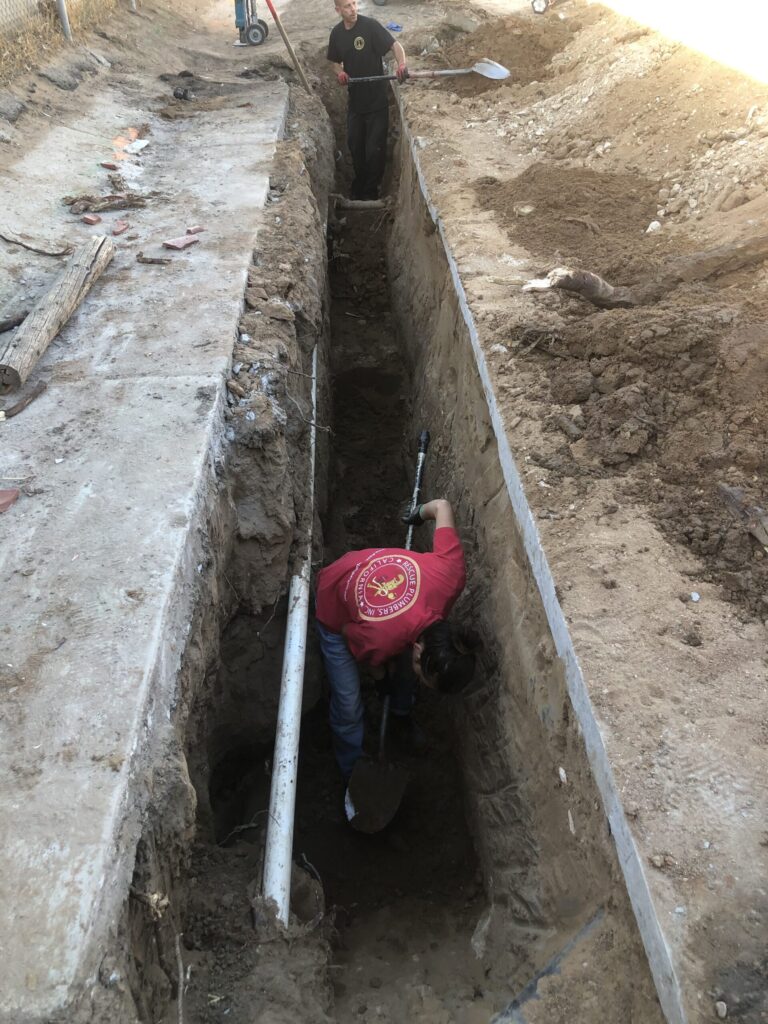
Attics, exterior wall cavities, and above ground runs feeding well houses and detached shops round out the list. Many properties in Pinon Hills, Oro Grande, Helendale, and Lucerne Valley run water from a well head or pressure tank to the house through pipe that sits above grade for part of its length, and that section is the single most vulnerable component on the property. Those runs need insulation, and in the coldest microclimates they may also need thermostatically controlled heat cable rated for potable water lines. Buried service lines should sit below the local frost depth, which varies across the High Desert and should be confirmed with the San Bernardino County building department before any new trench is dug. Lines that already run too shallow are worth relocating rather than simply wrapping. If you suspect a line on your property is exposed, undersized, or already showing signs of past freeze damage, click here for our water supply lines service and we will inspect the full run from the source to the house.
How To Insulate Pipes Correctly Before High Desert Winter
Doing this job right takes more than buying foam and pushing it onto a pipe. Material choice matters, seam sealing matters, and the details around joints, valves, and elbows are exactly where an incomplete installation fails first. A pipe that is ninety percent covered still has a ten percent exposure, and cold air finds that gap without any trouble. The good news is that the work is straightforward, the materials are inexpensive and widely available, and a homeowner with basic tools can handle most accessible runs. The sections below cover material selection, correct installation technique, and the mistakes that undo an otherwise solid job. Timing matters too, since foam is far easier to cut and seat in mild October weather than in a freezing garage in January.
Choosing The Right Pipe Insulation Material For High Desert Winter
Closed cell polyethylene foam sleeves are the workhorse of residential pipe insulation and the right choice for most interior applications. They arrive precut with a slit down one side, they come sized to standard copper and iron pipe dimensions, and many versions include a self sealing adhesive strip under a peel away liner. A half inch wall thickness is the common retail option and works well for garage and crawl space runs, while three quarter inch or one inch wall thickness provides meaningfully better performance on lines that face severe exposure. Buying the correct size for your pipe diameter is not optional, because a sleeve that is too large leaves an air gap and a sleeve that is too small will not close properly. Measure the outside diameter of the pipe before you shop, and remember that half inch copper and half inch PEX are not the same outside dimension. Foam is easy to cut with a utility knife and forgiving of imperfect angles.
Fiberglass pipe wrap with a foil or vinyl vapor barrier handles higher temperatures than foam and is the appropriate material immediately adjacent to a gas water heater flue or on any line that runs hot enough to soften polyethylene. It requires gloves and eye protection during installation and it must be sealed properly at the seams to keep the vapor barrier intact. Elastomeric rubber insulation costs more but resists compression, handles vibration well, and holds up better on lines that get bumped or leaned against in a working garage. For any pipe exposed to direct sunlight, material selection becomes critical in a way that surprises people. High Desert ultraviolet exposure at four thousand feet degrades standard polyethylene foam quickly, and a sleeve that looked fine in November can be crumbling and useless by the following summer.
Outdoor and above ground runs therefore need a protective jacket over the insulation rather than bare foam. Aluminum or PVC jacketing, UV rated tape wrapped completely over the sleeve, or a purpose built outdoor insulation product all solve the problem. Skipping this step is the most common reason well house piping fails a second time after a homeowner already insulated it once. Heat cable is the final piece for the most exposed situations, and it should always be a UL listed product rated specifically for potable water lines with an integral thermostat. Install the cable against the pipe first, then the insulation over the top of it, and follow the manufacturer instructions regarding overlap, since crossing cable over itself creates a fire hazard. Never use general purpose heat tape or improvised heating methods on a water line under any circumstances.
Installing Pipe Insulation The Right Way Before High Desert Winter
Begin by cleaning the pipe, because adhesive strips do not bond to dust and foam does not seat well over corrosion or old tape residue. Wipe the run down with a dry rag, then measure and cut your sleeve sections so the ends butt tightly against one another rather than leaving small gaps. Open the slit, seat the sleeve fully around the pipe so it makes contact all the way around, then press the adhesive strip closed along the entire length. If your product does not include adhesive, seal the seam with acrylic or foil tape rated for insulation, running the tape the full length rather than in spot patches. Every butt joint between two sections should get taped as well, since those small openings are exactly where cold air reaches the pipe. Work in the direction that lets gravity help you, and support long horizontal runs so the sleeve does not sag away from the pipe.
Elbows, tees, and valves take the most time and get skipped the most often. Miter cut the foam at a forty five degree angle so two pieces meet cleanly around a corner, then tape the joint thoroughly to close it. Preformed elbow and tee covers are available at most supply houses and save considerable time on a large job. Valve bodies and shutoffs need to be wrapped as well, using either tape style insulation or a foam section slit and fitted around the body, leaving the handle accessible so the valve can still be operated. Do not insulate over an accessible cleanout, a pressure relief discharge, or anything that needs to remain visible for inspection. Take photographs of the completed work before closing up a crawl space, since that record helps enormously during any future service call or insurance claim.
Insulation is one part of a complete winterization approach, and the surrounding steps multiply its effectiveness. Seal or cover foundation vents once overnight lows begin holding in the thirties, and close any gaps where pipes penetrate an exterior wall using expanding foam or caulk. Keep the garage door closed on freezing nights if a water heater or supply line lives in that space. During an unusually severe cold event, opening cabinet doors under sinks on exterior walls lets warm room air reach those pipes, and running a slow drip at the most vulnerable fixture keeps water moving so ice cannot form a solid plug. Know where your main shutoff valve is located and confirm that it actually turns, because a stuck valve during an active leak turns a repair into a disaster. If a line has already frozen this winter and you are seeing damp drywall, a jump in your water bill, or the sound of running water with everything off, click here for our leak detection service and we will find it before it spreads.
Common Pipe Insulation Mistakes To Avoid Before High Desert Winter
The mistake we see most often is partial coverage, where a homeowner insulates the easy straight sections and leaves every elbow, valve, and hard to reach segment bare. Cold air does not care that ninety percent of the run is protected, and the pipe will freeze at whichever point is most exposed. A related error is leaving the seam unsealed, which allows air to circulate inside the sleeve and largely defeats the purpose of installing it. Oversized sleeves create the same problem from a different direction, since the trapped air gap between foam and pipe conducts heat away almost as readily as no insulation at all. Compressing insulation with tight zip ties or straps also reduces performance, because the R value depends on the thickness of the material staying intact. Snug contact with a sealed seam is the target, not compression.
A second category of mistakes involves treating insulation as a substitute for heat rather than a supplement to it. Foam slows heat loss and nothing more, so a pipe with no warmth reaching it will eventually reach ambient temperature during a long cold stretch no matter how well it is wrapped. Vacant properties and seasonal homes in Wrightwood and the surrounding mountain communities need more than insulation, and full winterization with the system drained and the water heater shut down is the appropriate approach for an unoccupied house. Homeowners also frequently believe that PEX cannot freeze and burst, which is not accurate. PEX tubing does expand somewhat before failing, giving it better odds than rigid copper, but the fittings, manifolds, and valves in a PEX system remain rigid and crack readily under freeze pressure.
The most dangerous mistakes involve improvised heat and blocked ventilation. Never use a torch, a heat gun, or an open flame to thaw a frozen pipe, since that method has started house fires and can also cause a sealed section of pipe to rupture violently from steam pressure. Never wrap foam insulation around or against a gas appliance flue, and never allow insulation to block combustion air openings on a water heater closet. Non potable heat tape, extension cord powered heaters left unattended, and space heaters in crawl spaces create real fire risk and should be avoided entirely. Finally, do not insulate over an active leak or a corroded section in the hope that it will hold. Covering a failing pipe hides the evidence and lets damage accumulate out of sight, which is how a small drip becomes a rotted subfloor by spring.
Why You Need Professional Pipe Insulation Service In The High Desert
Plenty of pipe insulation work falls comfortably within the reach of a capable homeowner, and we encourage people to handle the accessible runs themselves. The job changes character once it involves a tight crawl space, an attic in triple digit heat, aging galvanized supply lines, gas appliance clearances, or an above ground well run that has already failed once. A licensed plumber brings the ability to evaluate the entire system rather than one visible section, which matters because the pipe you cannot see is usually the one that breaks. Rescue Plumbers Inc has served the High Desert for fifteen years and we know exactly how these homes are built, where the builders ran the lines, and which neighborhoods get hit hardest by a cold snap. We provide free, no obligation estimates and our technicians are not paid on commission, so the recommendation you receive reflects the condition of your plumbing and nothing else.
Signs You Need Professional Pipe Insulation Service Right Away
Certain conditions move this from a weekend project to a service call, and recognizing them early saves a great deal of money. Water pressure that drops noticeably on a cold morning and returns by afternoon is a strong indicator that a line is partially freezing somewhere you cannot see. Visible frost, condensation, or corrosion on a pipe in a crawl space or garage points to a section that is already cycling through temperature extremes. Any history of a previous freeze on the property matters, because the same vulnerable location will fail again under similar conditions. Water lines that run through an exterior wall or an unvented attic space are difficult to reach and generally warrant professional attention.
Older piping deserves a closer look before winter regardless of insulation status. Galvanized steel supply lines corrode from the inside over decades, and the resulting wall thinning leaves far less margin against freeze pressure than the original installation had. Homes built before the mid 1980s across Victorville, Barstow, and Apple Valley frequently still carry portions of original piping in less visible locations. Discolored water, recurring pinhole leaks, and pressure that has slowly declined over the years all suggest a system that needs evaluation rather than another layer of foam. A plumber can assess the pipe material, its condition, and its remaining service life during the same visit.
Properties on private wells carry additional exposure that a typical suburban home does not. Pressure tanks, pump housings, above ground runs between the well head and the house, and any pump house structure all present freeze points that need dedicated protection. Filtration and treatment equipment installed outdoors or in unheated buildings holds standing water and can crack in a hard freeze, which takes the whole system offline. Detached shops, barns, guest units, and RV hookups on High Desert acreage frequently have plumbing that nobody has looked at in years. A professional inspection maps every one of these vulnerabilities before the first freeze rather than after.
What To Expect From A Professional Pipe Insulation Service Visit
Our process starts with a full walkthrough of the property rather than a quick look at one pipe. We trace the water lines from the meter or well head through the house, identify every run passing through an unconditioned space, and note the pipe material, diameter, and condition at each point. We check the water heater connections, the expansion tank, the pressure regulator, and the main shutoff valve, since all of them are freeze candidates and all of them are easy to overlook. Exterior hose bibs, irrigation connections, and any above ground supply runs get inspected as well. You receive a clear explanation of what we found and a free, no obligation estimate before any work begins.
The installation itself is matched to each location rather than applied uniformly. We select material thickness and type based on the actual exposure of each run, use fiberglass where heat requires it, and install UV protected jacketing on anything that sees direct sunlight. Elbows, tees, valves, and joints are covered and sealed, not skipped, because those are the points that determine the outcome. Where a run genuinely needs more than insulation, we install properly rated and thermostatically controlled heat cable to manufacturer specification. We also address the surrounding conditions, sealing wall penetrations and advising on foundation vents and garage exposure.
Repairs and upgrades often come up during this work, and we handle them in the same visit whenever possible. Corroded sections get replaced, undersized runs get corrected, and lines that sit in an unworkable location get rerouted through conditioned space where that is practical. If an inspection turns up a system that has reached the end of its service life, we walk you through the options honestly and let you decide on your own timeline with no pressure. Every technician is licensed and insured, and we stand behind the work. To get a full look at the pipe running through your home before the first freeze, click here for our piping service.
Why Choose Rescue Plumbers Inc For Pipe Insulation Service In The High Desert
Rescue Plumbers Inc is a family owned and operated company working out of Phelan, and the High Desert is where we live rather than a market we drive into. Fifteen years of work in Adelanto, Apple Valley, Barstow, Helendale, Hesperia, Lucerne Valley, Mariana Ranchos, Oak Hills, Oro Grande, Pinon Hills, Spring Valley Lake, Wrightwood, and Victorville means we already know how the tract homes in one neighborhood were plumbed and how the custom builds on five acre parcels differ. That local knowledge shortens diagnostic time and produces better recommendations. When you call our office you reach an actual person who can answer questions about your specific situation. We think that kind of connection is what a plumbing company owes the community it operates in.
Our technicians do not work on commission, and that structure changes the entire dynamic of a service call. Nobody at this company earns more by talking you into a repipe you do not need or an upgrade that solves nothing. We tell you what the pipe condition actually is, what the realistic risk looks like heading into winter, and what it will cost to address it. Estimates are free and carry no obligation whatsoever, so you can get a professional assessment and then decide on your own terms. That approach has kept our customers coming back for fifteen years.
We are licensed, insured, and fully credentialed, and we bring that same standard to a small insulation job and a full system replacement alike. Freeze protection work is best done in September and October while the weather cooperates and schedules are open, since December call volume climbs quickly once the first hard freeze arrives. Call us at (760) 241-3100 or email fixit@rescueplumbersinc.com to schedule an inspection at your home. Our office is located at 6083 Lindero Rd in Phelan, CA 92371, and we serve the entire High Desert. Get your pipes protected now and skip the emergency call later this winter.