
What Happens When A Water Heater Expansion Tank Fails
A water heater expansion tank is a small steel tank mounted on the cold water supply line near your water heater, and its only job is to absorb the extra volume created when water heats up and expands inside a closed plumbing system. Inside that tank sits a rubber bladder with a cushion of compressed air behind it, and that air gives expanding water somewhere to go instead of forcing pressure back into your pipes and fixtures. When the bladder tears or the air charge bleeds off, the tank fills completely with water and stops doing anything useful at all. Pressure that used to be absorbed quietly now spikes every time the burner or the heating element fires, and the rest of your plumbing absorbs that abuse instead. Most homeowners never catch the failure until the temperature and pressure relief valve starts dripping onto the garage floor or a toilet fill valve begins cycling at odd hours of the night. Here in Phelan and across the High Desert, hard water and wide seasonal temperature swings push these tanks hard, and plenty of them quit working years before anyone thinks to check them. This guide covers what actually happens inside your plumbing when that tank fails, how to confirm the failure yourself, and what a proper repair looks like.
Warning Signs Your Water Heater Expansion Tank Failed
A failed expansion tank rarely announces itself with a dramatic leak or a loud bang, which is exactly why so many of them sit dead on the wall for years while doing quiet damage. The symptoms show up somewhere else in the house, usually at the weakest fitting or the oldest valve, and that misdirection sends homeowners chasing the wrong repair. A dripping relief valve gets replaced, a toilet gets a new fill valve, a faucet cartridge gets swapped out, and the real problem keeps building pressure every single heating cycle. Learning to read these signs correctly saves money, and it often saves the water heater itself. The three sections below cover the pressure symptoms you can observe, the two field tests that confirm a bad tank, and the damage a waterlogged tank causes when nobody catches it. Each test takes only a few minutes and requires nothing more than a tire gauge and a free hand.
The Pressure Symptoms of a Failed Water Heater Expansion Tank
The clearest signal of a failed water heater expansion tank is a temperature and pressure relief valve that drips or discharges after the heater runs. That valve is a safety device rated to open at 150 psi or 210 degrees Fahrenheit, and it is designed as a last resort, not as a pressure regulator for daily use. When your expansion tank stops absorbing thermal expansion, system pressure can climb past 150 psi within minutes of the burner firing, and the relief valve does exactly what it was built to do by dumping water out the discharge tube. Homeowners often notice the puddle first and assume the relief valve has simply worn out, so they replace it and consider the job finished. The new valve works fine for a few weeks or a few months, then it starts weeping too, because the underlying pressure problem never went away. Never cap, plug, or thread a shutoff onto that discharge line under any circumstance, since blocking the only pressure release on a water heater creates a genuine safety hazard. A relief valve that drips repeatedly is telling you something specific about your system pressure, and it deserves an actual diagnosis.
Fluctuating water pressure throughout the house is the second symptom, and it becomes obvious once you know how to measure it. Thread an inexpensive pressure gauge onto an outside hose bibb, run a few gallons of hot water to trigger a heating cycle, and then watch the reading over the next twenty to thirty minutes. A healthy system with a working expansion tank holds steady within a few psi of your static street pressure the entire time. A system with a failed tank will show a static reading around 60 or 70 psi that climbs steadily to 100, 120, or even higher as the water heats and has nowhere to expand. That climbing number is the entire failure captured in one measurement, and it explains almost every strange plumbing symptom in the house. You may also hear pipes knock or bang inside walls when a faucet closes, since high static pressure makes water hammer far more violent than it should be.
Fixture problems that keep coming back are the third symptom, and they tend to appear in clusters rather than one at a time. Toilet fill valves start running for a few seconds at random through the night because pressure pushes past a flapper or a worn seal that would otherwise hold just fine. Faucet cartridges begin dripping months after replacement, angle stops under sinks start weeping at the packing nut, and braided supply lines bulge or seep at the crimped ends. Washing machine hoses and refrigerator water lines are especially vulnerable, since they sit under constant pressure and were never designed for repeated spikes above 100 psi. If you find yourself repairing several unrelated fixtures in the same year, the common factor is usually pressure rather than bad luck or cheap parts. Fixing the fixtures without fixing the pressure means paying for the same repairs again. Need a fixture repaired correctly the first time? Click here for our faucet repair service.
How to Test a Water Heater Expansion Tank for Failure
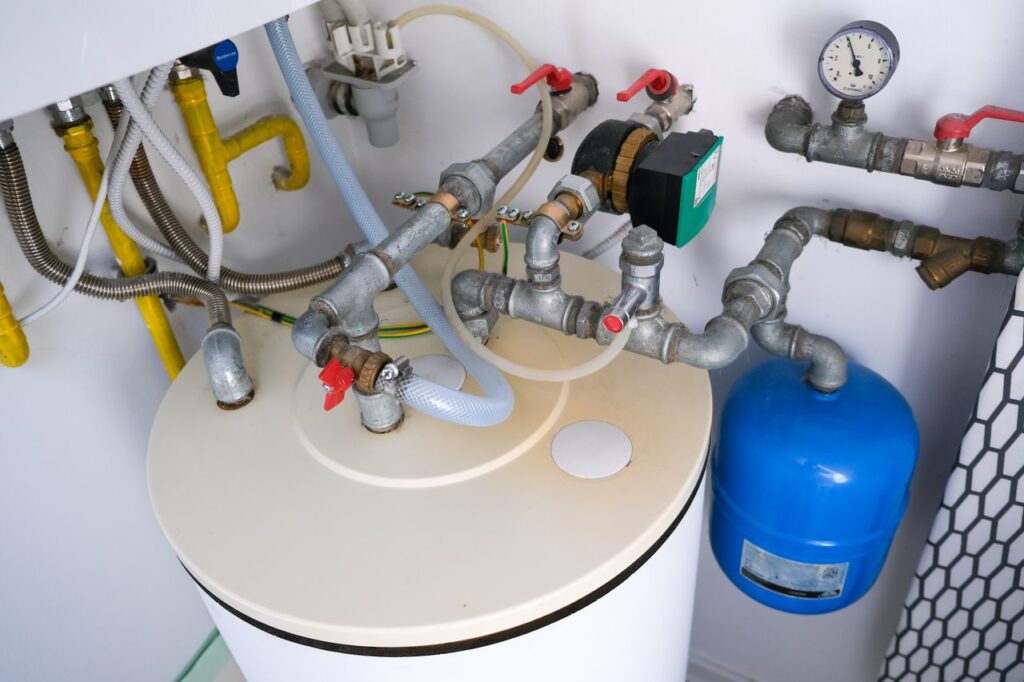
The tap test is the fastest way to check a water heater expansion tank, and it takes about ten seconds. Rap your knuckles firmly against the top half of the tank, then rap the bottom half and listen closely to the difference between the two sounds. A properly functioning tank sounds hollow and light across the top where the air charge lives, and solid or dull across the bottom where the water sits behind the bladder. A failed tank sounds dull and solid from top to bottom because water has filled the entire vessel and pushed the air out or absorbed it. You can confirm the same thing by feel, since a two gallon tank full of water weighs noticeably more than an empty one and often feels heavy enough to sag on its mounting bracket. This test tells you the tank is waterlogged, though it does not tell you the reason, which matters when deciding on the correct fix. Any tank that sounds solid across the top needs attention right away.
The Schrader valve test confirms a torn bladder and takes almost no effort. Pull the plastic cap off the air fitting at the bottom or end of the tank, which looks and functions exactly like the valve stem on a car tire. Press the pin briefly with a small screwdriver or the back of a tire gauge and pay attention to what comes out of it. Air escaping means the bladder is still intact, and the tank may only need its air charge restored to the correct pressure. Water spraying or dribbling out of that valve means the rubber bladder has torn, and water has crossed into the air chamber where it never belongs. A tank with a ruptured bladder cannot be recharged, repaired, or rebuilt, and any attempt to add air to it simply pushes air into your water supply. Replacement is the only correct answer at that point, and the failure will not reverse itself.
Checking the precharge pressure requires one extra step that people frequently skip, and skipping it produces a meaningless number. The tank must be isolated from house pressure before you measure, which means shutting off the cold water supply to the water heater and opening a hot water faucet or the heater drain to relieve pressure on the line. With water pressure still applied, a tire gauge on the Schrader valve reads system pressure through the bladder rather than the actual air charge, so the tank looks fine even when it is completely dead. Once the line is depressurized, put the gauge on the valve and compare the reading to your static house pressure measured at the hose bibb. Those two numbers should match within about two psi of each other, and a tank reading 20 psi against 65 psi of street pressure is functionally useless. A bicycle pump or small compressor can bring a low tank back up to spec if the bladder is intact and the shell is sound. A tank that refuses to hold that charge for more than a few days has a leaking valve core or a failed shell and needs to be swapped out.
Why a Waterlogged Water Heater Expansion Tank Damages Plumbing
Water does not compress, and that single physical fact explains all the damage a failed expansion tank causes. Heating fifty gallons of water from around 55 degrees to 120 degrees creates roughly a half gallon to a full gallon of additional volume that has to go somewhere. In an open system, that extra volume simply pushes back into the city main and disappears without consequence. Nearly every home in our service area has a closed system created by a pressure regulator, a check valve, or a backflow preventer at the meter, and those devices allow water in while blocking it from flowing back out. With the expansion tank waterlogged and the return path sealed, that extra volume has exactly nowhere to go, so pressure rises instead. Plumbing codes cap static water pressure at 80 psi for good reason, and thermal spikes routinely double that number in a closed system with a dead tank. Every fitting, valve, seal, and appliance in the house lives with those spikes several times a day.
The water heater itself takes the worst of the punishment, which is a costly irony given that the tank exists to protect it. Repeated pressure cycling flexes the glass lining inside the steel tank, and that lining is what stands between your water and bare steel. Microscopic cracks in the lining expose the steel underneath, corrosion begins at those points, and the anode rod gets consumed far faster while trying to compensate. Tank seams and the welds around the fittings work harder than they were designed to, and the drain valve and the relief valve both wear out ahead of schedule. A water heater that should deliver ten to twelve years of service can fail in six or seven when it spends its life absorbing pressure spikes. The failure usually arrives as a leak from the bottom seam, which means water on the floor and an emergency replacement rather than a planned one. Replacing a failed expansion tank costs a small fraction of what replacing a water heater costs.
The weight of a waterlogged tank creates a second problem that has nothing to do with pressure at all. An empty two gallon expansion tank weighs about six pounds, and the same tank full of water weighs well over twenty pounds hanging off a threaded fitting. That load pulls on the tee, the nipple, and the copper or PEX supply line holding it, and the stress concentrates right at the threads where the tank meets the pipe. Over time the joint works loose, a slow drip starts behind the water heater, and the moisture sits unnoticed on a garage floor or inside a closet for months. Homes in seismic areas face an added risk, since an unsupported heavy tank swings during ground movement and can tear the connection open completely. Any leak near a water heater deserves prompt attention, because the damage spreads into drywall, framing, and flooring long before it becomes visible. Seeing water where it does not belong? Click here for our leak detection service.
What Causes a Water Heater Expansion Tank to Fail
Expansion tanks are simple devices with only a few parts, so the list of failure causes is short and predictable. Water chemistry attacks the bladder and the interior shell, incorrect precharge pressure works the bladder to death, and poor mounting stresses the connection until something gives. Age eventually finishes off whatever survived the first three, since rubber does not last forever under constant flexing and mineral exposure. Understanding the cause matters because a tank that failed from bad precharge will fail again in short order if the replacement gets installed the same wrong way. Homes in Phelan, Pinon Hills, Oak Hills, and Wrightwood share the same challenging water and pressure conditions, and those conditions shorten tank life across the board. The sections below break down each cause and what can be done about it.
Hard Water and Sediment Cause Water Heater Expansion Tank Failure
High Desert water carries a heavy mineral load, primarily calcium and magnesium, and those minerals do not stay dissolved once water gets hot. Scale forms on every surface the hot water touches, and the expansion tank sits directly in that path on the cold line where thermal migration still brings warm water into contact with the bladder. Mineral deposits build on the rubber surface and turn a flexible membrane into a stiff one that cracks instead of stretching. Sediment also settles into the bottom of the tank where it holds moisture against the steel and accelerates corrosion from the inside out. A tank that would last ten years on soft municipal water may only give five or six years of reliable service here. Homeowners who install whole house filtration or softening systems consistently get longer life out of expansion tanks, water heaters, and fixtures alike. The water quality problem does not stop at one appliance, and neither does the solution.
Chlorine and chloramine in treated water attack rubber compounds directly, which compounds the mineral problem. Butyl and EPDM bladders hold up reasonably well against normal disinfectant levels, though years of continuous exposure still degrade the material and reduce its elasticity. A bladder that has hardened cannot flex through its full range, so it works only a fraction of its intended volume before splitting along a crease. That split usually starts small and grows, which is why some tanks fail gradually while others go all at once. Cheap tanks with thin bladders fail noticeably faster than quality units built with heavier membranes and better internal coatings. Paying a bit more for a well built tank pays for itself the first time you avoid a service call.
Corrosion of the steel shell is the third water related failure, and it is the one you can actually see. Look at the bottom seam and around the threaded connection for rust staining, bubbling paint, or a chalky white mineral crust. Any of those marks means moisture has been present and the shell is compromised, and a rusted shell can eventually split under pressure and release its entire volume at once. Mixing metals at the connection makes this worse, since a steel tank threaded directly onto copper without a proper dielectric or brass transition creates galvanic corrosion at the joint. Correct installation practice uses appropriate transition fittings to keep dissimilar metals from eating each other. A rusted tank is not a candidate for recharging or repair under any circumstance. Ready for a properly installed replacement? Click here for our water heater expansion tank service.
Wrong Precharge Pressure Causes Water Heater Expansion Tank Failure
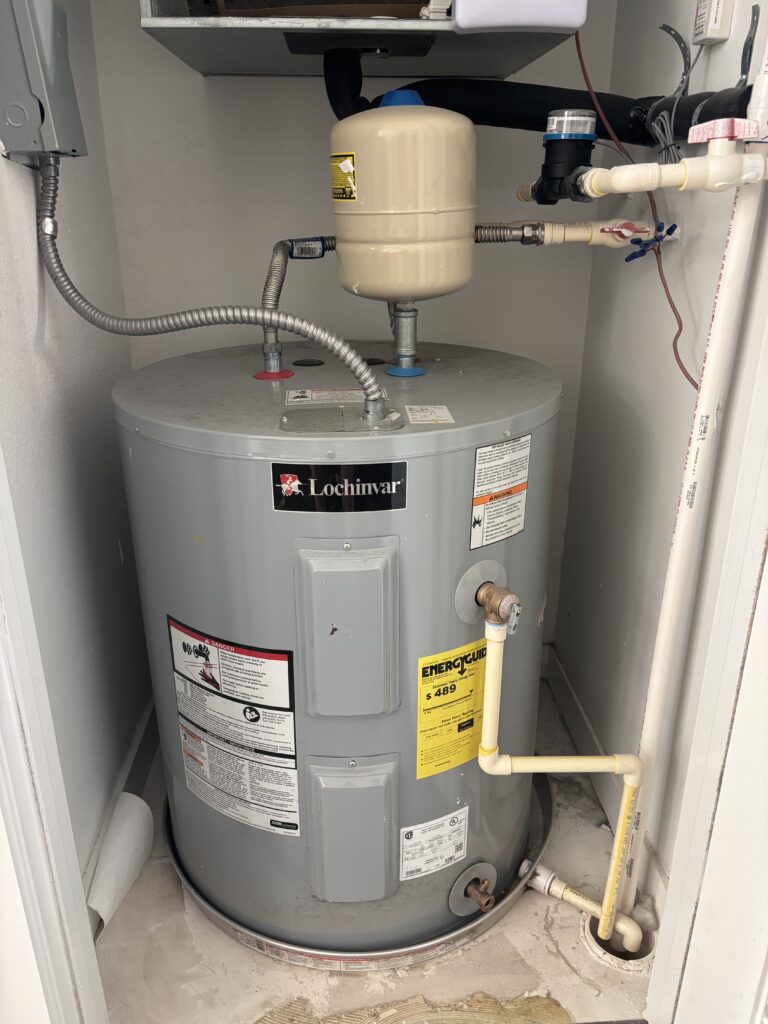
Every expansion tank leaves the factory with a standard air charge, commonly around 40 psi, and that number is a starting point rather than a final setting. The precharge has to be adjusted to match the static water pressure in the specific home where it is installed, measured before any water reaches the tank. Skipping that adjustment is the single most common installation error we find in the field, and it guarantees a shortened tank life. If house pressure runs 70 psi and the tank sits at 40 psi, water pushes the bladder fully against the top of the tank and holds it there permanently. The tank has no usable volume in that state, so it absorbs nothing and the bladder never gets to relax. Pressure spikes continue exactly as they would with no tank installed at all, and the compressed bladder cracks under the constant strain. Correct precharge is not a detail to eyeball, and it is the difference between a tank that lasts a decade and one that dies in two years.
The opposite error causes its own set of problems. Setting the precharge well above house pressure means the bladder never moves, since incoming water lacks the force to compress the air behind it. The tank stays permanently empty, the system gains no expansion capacity, and the relief valve ends up doing the work instead. Homes with a pressure regulating valve at the meter add another variable, since these devices drift out of adjustment as they age and their internal springs weaken. A regulator that was set to 60 psi during construction may deliver 90 psi fifteen years later without anyone noticing. When street pressure changes, the tank precharge needs to be rechecked and reset to match. This is exactly why an annual pressure check belongs on your maintenance list alongside flushing the water heater.
Air migration through the bladder happens slowly in every tank, and it is a normal part of aging rather than a defect. Rubber is permeable at a microscopic level, so a small amount of air passes into the water side over the years and the precharge gradually drops. A tank that reads 65 psi at installation may read 45 psi after five years even with a perfectly intact bladder. Once the charge falls significantly below system pressure, the tank waterlogs and functions as dead weight on the pipe. Checking the precharge annually and topping it off with a bicycle pump takes about fifteen minutes and can add years of useful life. Leaking valve cores cause the same drop much faster, and a core is inexpensive to replace when the shell and bladder are still sound. Regular checks catch these issues while they are still simple fixes.
Poor Mounting and Age Cause Water Heater Expansion Tank Failure
Many expansion tanks in this area hang unsupported from the cold water line with nothing but a threaded fitting holding them in place. That arrangement works acceptably while the tank is light and empty, and it becomes a real problem the moment the tank waterlogs and gains fifteen or twenty pounds. The load bends the supply line, stresses the soldered or crimped joints nearby, and eventually opens a leak at the weakest connection. Proper installation supports the tank with a strap or a bracket anchored to framing so the weight never rests on the plumbing. This matters even more in our region, where seismic activity is a genuine consideration and California code already requires water heaters to be strapped in place. A tank that swings freely during ground movement can shear its fitting and release water at full pressure. Support hardware costs very little and prevents an expensive category of failure.
Orientation and location affect tank life as well, and both are easy to get wrong. Manufacturers specify acceptable mounting positions, and installing a tank in an unapproved orientation lets sediment collect against the bladder or puts uneven load on the membrane. Garages and unconditioned utility spaces in Phelan and Wrightwood see wide temperature swings between summer afternoons and winter nights, and repeated thermal cycling works the rubber harder. Tanks mounted where they take direct sun through a window or sit against a hot flue degrade faster than those in stable conditions. Keeping the tank accessible also matters practically, since a tank buried behind stored boxes never gets checked and never gets serviced. Good placement is part of a good installation, not an afterthought.
Age catches up with every expansion tank eventually, and planning for that reality prevents surprises. Most residential units carry warranties in the five year range, and real world service life typically falls between five and ten years depending on water quality, precharge accuracy, and mounting. A tank that reached its tenth birthday has already outlived the average, and replacing it before it fails is far cheaper than dealing with the damage afterward. The best time to replace an expansion tank is during a water heater replacement, since the labor overlaps and the new tank matches the new heater’s expected life. Installing a fresh water heater onto a decade old expansion tank leaves an obvious weak point in an otherwise new system. Ask about the tank any time your heater gets serviced or replaced.
Why You Need Water Heater Expansion Tank Service Before Winter
Fall is the right time to deal with an expansion tank, and the reason is straightforward. Incoming water temperature drops as the season turns, which means your water heater has to raise that water further to reach the same setpoint. Longer heating cycles and a greater temperature rise produce more thermal expansion per cycle, so a marginal tank that limped through the summer often fails outright once the cold arrives. Holiday guests, extra laundry, and back to back showers push demand higher at the same moment the system is working hardest. Catching a bad tank now means a scheduled visit and a straightforward part swap instead of an emergency call on a cold morning with water on the floor. The repair is quick, the parts are affordable, and the protection it restores extends to your entire plumbing system.
What a Professional Water Heater Expansion Tank Replacement Includes
A proper expansion tank replacement starts with measurement rather than parts. We check static water pressure at a hose bibb, verify the pressure regulator is holding its setting, and confirm the system is in fact closed before recommending anything. Tank sizing gets matched to the water heater capacity and the measured pressure, since a two gallon tank suits a typical forty or fifty gallon residential heater while larger heaters need more expansion volume. Undersized tanks fail early and oversized ones waste money, so getting this right at the start matters. The old tank comes off, the fitting gets inspected for corrosion and replaced if needed, and the connection is made with appropriate transition materials.
Precharging happens before the new tank ever sees water, which is the step that separates a lasting installation from a repeat call. We set the air charge with a gauge to match the static pressure we measured in your home, not to whatever the factory shipped. The tank gets mounted with proper support so its weight rests on structure instead of on your supply line, and the orientation follows manufacturer specification. Once water is restored, we check for leaks at every joint and verify that pressure holds steady through a full heating cycle. That verification step confirms the repair actually solved the problem you called about.
A complete visit also includes a look at the rest of the water heater, because expansion tank failures rarely happen in isolation. We inspect the relief valve and its discharge line, check the anode rod condition when access allows, look for sediment buildup, and confirm the seismic strapping meets code. Any of those items can create its own problem, and finding them during a scheduled visit costs far less than finding them during a flood. You get a clear explanation of what we found and what needs attention now versus later. Want a full checkup before the cold sets in? Click here for our water heater inspection service.
The Cost of Ignoring a Failed Water Heater Expansion Tank
Putting off an expansion tank replacement is one of the more expensive delays in home plumbing, mostly because the cost shows up somewhere else. A relief valve dripping onto a garage floor seems like a minor annoyance until you total the water waste over several months of continuous seepage. Fixture repairs pile up as high pressure destroys cartridges, angle stops, supply lines, and fill valves throughout the house. Each of those repairs feels small on its own, and together they easily exceed what the tank replacement would have cost. The pattern is predictable once you know what causes it.
The larger risk is the water heater itself, which is the most expensive item in the chain. Pressure cycling shortens heater life significantly, and a heater that fails from a split seam does not fail politely. Water spreads across the garage or into the hallway, drywall wicks it up, flooring lifts, and stored belongings get soaked. Replacement then becomes an emergency rather than a planned expense, with no time to compare options or schedule around your calendar. A working expansion tank is inexpensive insurance against that outcome.
Burst supply lines represent the worst case, and they happen more often than people expect. A braided washing machine hose or a plastic angle stop that lets go while nobody is home releases water continuously at full pressure. Insurance may cover part of the damage, though the deductible, the disruption, and the repair timeline all land on you. High static pressure is the common thread behind most of these failures, and an expansion tank is a primary defense against it. Handling the small repair now removes the large one from your future.
Why Choose Rescue Plumbers Inc for Water Heater Expansion Tank Service
Rescue Plumbers Inc is a family owned and operated company based right here at 6083 Lindero Rd in Phelan, and we have served the High Desert for fifteen years. Our technicians are not paid on commission, which means nobody has a financial reason to sell you a water heater when a twenty dollar valve core would solve your problem. We diagnose the actual issue, explain what we found in plain terms, and give you a free estimate with no obligation attached. You decide what to do with the information, and we respect that decision either way. That approach has kept our customers calling us back for over a decade.
We know the water in this region because we live with it too. Phelan, Pinon Hills, Oak Hills, Hesperia, Apple Valley, Victorville, and Wrightwood all present the same combination of mineral heavy water and demanding conditions, and we size and precharge every expansion tank with those realities in mind. Our crews are licensed and insured, our work meets California plumbing code, and we support and strap every installation the way it should be done. When you call, you reach a real person instead of a phone tree or an answering service in another state. That connection is part of what truly local service means.
Reach us at (760) 241-3100 or send a message to fixit@rescueplumbersinc.com to schedule a water heater expansion tank inspection or replacement. We will check your system pressure, test the tank, and tell you exactly where things stand before any work begins. Most expansion tank replacements are completed in a single visit at a fair and clearly stated price. Getting this handled before winter demand peaks protects your water heater, your fixtures, and your home. Give us a call and let us take a look.