
How A Tankless Water Heater Saves Space And Energy
A tankless water heater heats water only at the moment you ask for it. There is no 50 gallon tank sitting in your garage, holding hot water all day and losing heat into the air. Instead, a compact unit hangs on the wall, fires a burner or an element the second a hot tap opens, and shuts down when you close it. High Desert homeowners in Phelan, Hesperia, and Victorville notice two things right away: the floor space that opens up, and the change in the monthly gas bill. Summer is the smartest season to make the switch, because incoming groundwater is warmer right now, which means a tankless unit delivers more gallons per minute at your target temperature. It is also the season when your energy budget is already stretched by air conditioning, so trimming water heating waste has a visible effect. Making the change in July also means your household is ready long before the cold weather months, when hot water demand climbs and every plumbing company in the Victor Valley is booked solid. This guide walks through exactly how a tankless water heater saves space, how it saves energy, and what a correct installation requires in our area.
How A Tankless Water Heater Saves Space In Your Home
Space savings are the easiest benefit to see, because the difference is physical and immediate. A standard 40 or 50 gallon storage tank stands roughly five feet tall and measures 18 to 24 inches across, and code requires working clearance around it for service and combustion air. A tankless unit is closer in size to a small carry on suitcase, commonly around 27 inches tall, 17 inches wide, and 10 inches deep. It mounts to the wall, which means the floor underneath becomes usable again. In a garage, that reclaimed corner becomes shelving, a workbench, or the storage bins that never had a home. In a hallway utility closet, it can be the difference between a cramped space and one that finally holds a washer, a dryer, and a laundry sink. The savings compound in older Phelan and Pinon Hills homes where the water heater was squeezed into whatever spot the original builder could find.
Tankless Water Heater Space Savings In The Garage And Utility Closet
Most homes in Phelan and Oak Hills keep the water heater in the garage, and that tank occupies a footprint of four to six square feet once you account for the required clearances. Add the seismic strapping, the drain pan, the gas shutoff, and the flexible connectors, and that corner becomes untouchable. Removing the tank and mounting a tankless unit on the same wall gives that floor space back completely. Homeowners typically use it for a tool chest, a second refrigerator, or the storage that had been living in the third bay. The unit sits above head height in many installations, so nothing bumps into it. Service access stays easy, because the water and gas connections are all on the bottom face of the cabinet at a comfortable working height. For a two car garage that has been serving as a one car garage plus storage, this single change often restores enough room to park the second vehicle.
Utility closets tell a similar story with tighter margins. A closet built around a 40 gallon tank has almost no usable volume left once the tank, the venting, and the clearance are accounted for. Pull the tank, and the closet becomes a real storage space with room for shelving from floor to ceiling. Some homeowners convert that closet into a laundry area, which pairs well with a hot water source that never runs out mid cycle. If you are considering that kind of change, the plumbing rough in for washer boxes, drains, and vents needs to be planned alongside the water heater work. Doing both at the same time saves labor and avoids opening the same wall twice. Our team handles that coordination on a regular basis in Apple Valley and Spring Valley Lake homes.
Interior closet installations do come with real requirements, and this is where professional work matters. Gas tankless units use sealed combustion with a dedicated intake and exhaust, so the existing B vent from an old atmospheric tank is almost never reusable. Condensing models vent through PVC or polypropylene pipe and also produce acidic condensate that has to drain properly, often through a neutralizer. Clearances to combustible materials, access panels, and the routing of that vent through the roof or an exterior wall all have to follow the manufacturer instructions and the California Plumbing Code. Skipping any of that creates a combustion safety problem, not just a code problem. Need a tankless unit installed correctly the first time? Click here for our water heater installation service. We size, vent, and permit the job so it passes inspection and runs safely for decades.
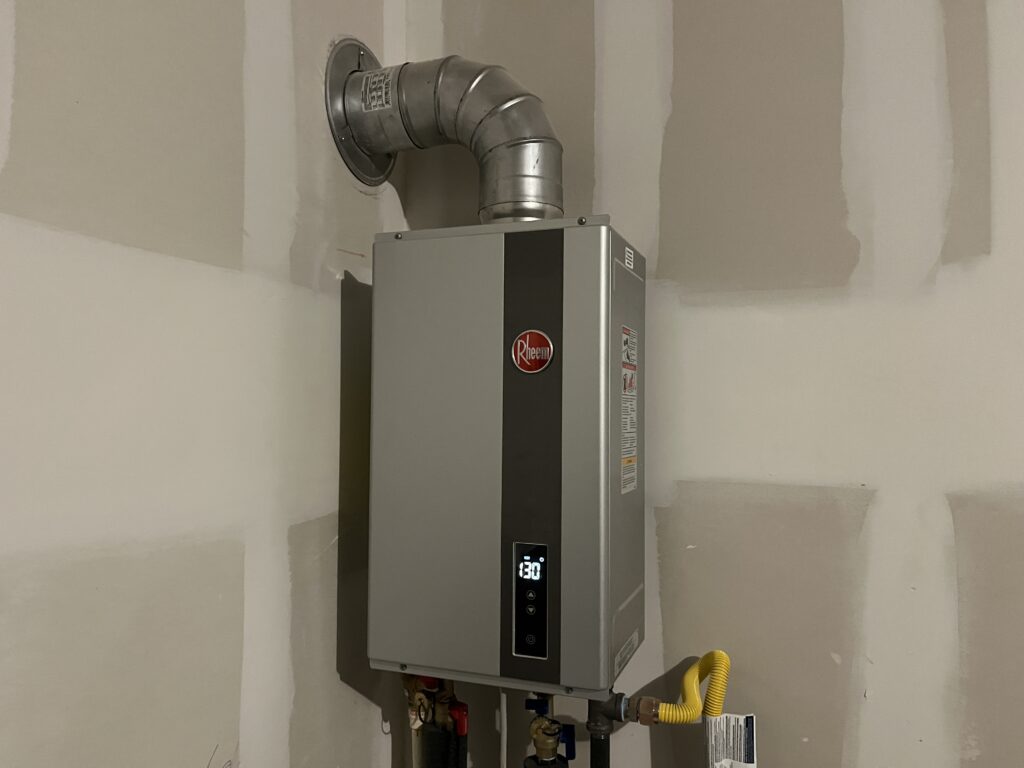
How Tankless Water Heater Wall Mounting Frees Up Usable Floor Space
Wall mounting is what makes the space savings possible, and it changes how the whole mechanical area functions. A tank sits on the floor because it has to; it weighs over 400 pounds when full and needs a stable, level base plus a drain pan under it. A tankless unit weighs somewhere between 50 and 90 pounds dry and stays near empty between uses, so it can be anchored to studs or to a block wall with the right hardware. That vertical placement lifts the equipment out of the walking path and out of the flood path. In a garage where boxes and bikes get stacked against the wall, having the heater at chest height or higher keeps it from being buried. It also keeps it away from vehicle exhaust and stored chemicals, which shortens the life of any gas appliance sitting at floor level.
There is a real water damage benefit to getting the equipment off the floor. A failing storage tank does not usually leak politely; it can dump its entire volume across a garage slab or, worse, into a finished interior space. A tankless unit holds only the small amount of water inside its heat exchanger at any moment, so a failure releases ounces rather than gallons. That is a meaningful difference in a home with a converted garage, a finished bonus room, or a slab that drains toward the interior. It also matters for homes in Wrightwood and Lucerne Valley where a leak might go unnoticed during a stretch away from the property. Fewer gallons on the floor means less drywall, flooring, and framing damage to repair.
Exterior wall mounting is another option that our High Desert climate supports for much of the year, and it moves the equipment out of the house entirely. Outdoor rated tankless models are built for direct exposure and need no interior venting at all, which simplifies the installation considerably. The caution is winter. Built in freeze protection on these units relies on electricity, so a hard freeze combined with a power outage can damage the heat exchanger, and elevations like Wrightwood and Pinon Hills see both. We evaluate elevation, wind exposure, and the practicality of adding a freeze protection kit before recommending an exterior location. When outdoor mounting is the right call, it frees up interior square footage that no other appliance change can match.
Tankless Water Heater Space Savings For Additions, Casitas, And Remodels
Room additions and accessory dwelling units are where tankless space savings pay off most, because square footage there is expensive. Dedicating a five foot tall mechanical corner to a storage tank inside a 600 square foot casita is a poor trade. A wall mounted tankless unit can be tucked into an exterior wall alcove, a shallow closet, or the outside face of the structure without stealing living space. That flexibility often lets a designer keep a full closet or a pantry that would otherwise be sacrificed. It also removes the need for a floor drain or pan in the living area. For homeowners building an addition in Apple Valley or Hesperia, that difference shows up directly in the usable layout.
Bathroom and kitchen remodels benefit for a slightly different reason. Adding a soaking tub, a second shower head, or a larger dishwasher increases hot water demand, and an existing 40 gallon tank may not keep up. Rather than upsizing to a 75 gallon tank and losing even more floor space, a properly sized tankless unit delivers continuous hot water without growing at all. Gas models commonly produce 5 to 10 gallons per minute depending on the temperature rise required, which covers multiple fixtures running at once in most homes. That sizing math is the whole ballgame, and it depends on your incoming water temperature and your peak simultaneous demand. Planning a remodel that adds fixtures? Click here for our plumbing services for remodels and home additions.
There is also a smart middle path worth knowing about. Point of use tankless units are small heaters installed near a single fixture, and they are excellent for a detached shop, a guest bath at the far end of a long ranch home, or a wet bar. Because they sit within a few feet of the tap, hot water arrives almost instantly and you stop wasting the water that normally runs down the drain while you wait. In sprawling High Desert properties with long horizontal runs, that waste adds up quickly across a year. These small units can supplement a main water heater rather than replace it. We size them by fixture demand and available power or gas supply, then place them where the run length actually justifies the equipment.
How A Tankless Water Heater Saves Energy And Lowers Your Utility Bills
Energy savings come from a simple mechanism: a tankless water heater does not keep 50 gallons hot around the clock. A storage tank loses heat through its walls continuously, reheating over and over even when nobody is home. That loss is called standby heat loss, and it is pure waste. The Department of Energy reports that homes using 41 gallons or less of hot water per day can see 24% to 34% better energy efficiency from a demand water heater compared to a conventional storage tank. Homes with heavier use, around 86 gallons per day, still see roughly 8% to 14% better efficiency. Installing separate demand heaters at individual outlets can push savings as high as 27% to 50% in the right layout. Those percentages apply to the water heating portion of your bill, which is typically the second largest energy use in a home after heating and cooling.
Tankless Water Heater Energy Savings From Eliminating Standby Heat Loss
Standby heat loss is easy to picture once you understand what a tank is actually doing. It heats water to a setpoint, usually 120 degrees, and then holds it there for hours regardless of use. Heat migrates through the insulation, out the flue, and into the surrounding air, so the burner cycles on periodically just to maintain temperature. During a two week vacation, that tank fires hundreds of times to heat water nobody touches. Overnight, it does the same thing while the household sleeps. A tankless unit sits completely idle in those hours and consumes essentially nothing. The burner only lights when flow through the unit exceeds roughly half a gallon per minute, meaning a hot tap has to actually be open.
The effect is more pronounced for households with irregular schedules. Retirees who travel, families with kids away at school, seasonal residents, and anyone with a second property all pay to keep water hot during long stretches of zero demand. Vacation mode on a tank helps a little but does not eliminate the problem. With a tankless system, low use periods cost almost nothing, and heavy use periods cost only what the hot water actually required. That alignment between energy spent and hot water delivered is the core of the savings. Over a full year, it removes a fixed baseline cost from your gas bill.
Garage placement in our climate adds another wrinkle worth understanding. High Desert garages swing from below freezing on January mornings to well over 110 degrees in July afternoons. Cold ambient air pulls heat out of a storage tank faster, so standby losses climb in winter exactly when incoming water is coldest and the burner already has to work harder. A tankless unit is unaffected by that swing because there is no stored volume to protect. The other summer advantage is temperature rise. Groundwater entering your home in July might arrive around 70 degrees, and raising it to 120 requires a 50 degree rise, well within the capacity of a properly sized gas unit even with two fixtures running.
How Tankless Water Heater Efficiency Ratings Translate Into Lower Energy Bills
Uniform Energy Factor, or UEF, is the number to look at when comparing units. It measures how much of the fuel you buy actually ends up as hot water at the tap. A conventional atmospheric vent gas storage tank typically lands somewhere around 0.60 to 0.70 UEF. A non condensing tankless unit generally runs near 0.81 to 0.85. A condensing tankless unit, which captures additional heat from the exhaust gases before they leave the building, commonly reaches 0.93 or higher. That spread is the difference between paying for heat that goes up the flue and paying for heat that reaches your shower. Higher UEF units cost more up front and pay that back through lower monthly consumption.
Condensing models earn their rating through a second heat exchanger. Exhaust from the primary burner still carries usable heat, and the secondary exchanger pulls it out before venting, cooling the flue gases enough that water vapor condenses. That condensate is mildly acidic and must drain to an approved location, often through a neutralizer cartridge, which is a code and longevity issue rather than an optional accessory. Because the flue gases run cooler, these units vent through PVC or polypropylene instead of stainless steel, which usually lowers the venting material cost. The tradeoff is the added drain requirement and slightly more maintenance. For most Phelan and Oak Hills households with normal to heavy hot water use, the higher efficiency model is the better long term math.
Correct sizing protects the efficiency you paid for. A unit that is undersized for your peak demand will short you on temperature during simultaneous use, and an oversized unit costs more without delivering proportional benefit. We calculate flow rate needs by adding up the fixtures likely to run at the same time, then check the required temperature rise against your coldest incoming water temperature, not your July temperature. Gas supply matters just as much. A tankless unit may demand 150,000 to 199,000 BTU per hour compared to about 40,000 for a tank, which frequently requires upsizing the gas line to 3/4 inch or larger and verifying the meter capacity. Need your gas supply evaluated or upgraded for a new appliance? Click here for our gas line installation service.
Tankless Water Heater Energy Savings Across A 20 Year Service Life
Service life is where the total savings picture comes together. A storage tank in our hard water region often reaches the end of its useful life in 8 to 12 years, and that timeline shortens when sediment builds on the tank bottom and the anode rod goes unchecked. A well maintained tankless unit commonly runs 20 years or more, and most manufacturers build them with replaceable parts rather than a sealed vessel that must be discarded. Over two decades, that difference typically means buying and installing one tankless system instead of two tanks. Add the monthly energy savings across all those years and the arithmetic changes considerably. The up front cost is higher; the lifetime cost usually is not.
Repairability is an underrated part of that math. When a storage tank fails, it is almost always because the steel vessel has corroded through, and there is no repair for that. When a tankless unit has a problem, it is usually a flow sensor, an igniter, a fan motor, or a scaled heat exchanger, and every one of those is a serviceable component. Parts are available, labor is a fraction of a full replacement, and the unit returns to full efficiency afterward. That is why a tankless system can hold its performance in year 15 rather than steadily declining. Running into performance issues with an existing unit? Click here for our water heater repair service.
Local utility rebate programs sometimes reduce the up front cost for high efficiency water heating equipment, and those programs change from year to year. Federal incentives have also shifted recently, so anything you read in an older article may no longer apply. We tell customers to verify current offers directly with their gas and electric providers before assuming a credit is available. What does not change is the underlying efficiency gain, which shows up on the bill regardless of any program. Treat rebates as a bonus rather than the reason for the decision. The energy math stands on its own over a 20 year horizon.
Why You Need Professional Tankless Water Heater Installation In Phelan And The High Desert
Tankless water heaters reward correct installation and punish shortcuts. The unit has to be sized to your actual demand, supplied with adequate gas volume, vented with the right material to the right termination point, and connected with isolation valves so it can be serviced. Hard water in the Victor Valley makes annual descaling a requirement, not a suggestion. Permits are required in San Bernardino County for water heater replacement, and inspection protects you at resale. Rescue Plumbers Inc has been doing this work locally for 15 years, and we install these systems the way the manufacturer and the code require. Call (760) 241-3100 for a free, no obligation estimate.
What A Professional Tankless Water Heater Installation Includes
A proper installation starts with a load calculation, not a product recommendation. We count your fixtures, ask how your household actually uses hot water, and measure the incoming water temperature at its coldest seasonal point. From there we determine the flow rate and BTU input the unit must deliver. Next comes the gas supply check, which involves the pipe size, the total run length, the other appliances on the system, and the meter capacity. Undersized gas piping is one of the most common problems we find on units installed by others. Getting it right at this stage is what prevents temperature swings and lockout codes later.
The physical installation covers mounting, water connections, venting, condensate handling, and electrical. We anchor the unit securely to structure, install isolation valves with service ports on the hot and cold sides, and run the venting in the material the manufacturer specifies with correct clearances at the termination. Condensing units get a properly routed condensate drain. Gas connections are leak tested, and the unit is commissioned with the correct setpoint and any recirculation settings your home requires. We then walk you through operation, error codes, and the maintenance schedule.
Permitting and inspection close out the job. San Bernardino County requires a permit for water heater replacement, and an inspected installation is documentation you will want at resale. It also means a second set of eyes confirming the venting, gas, and clearances are correct. We handle the paperwork so you are not tracking it down. Every job is performed by licensed and insured technicians who are not paid on commission, so nobody on our crew has a financial reason to sell you a larger unit than your home needs. That structure is deliberate, and our customers notice it.

Tankless Water Heater Maintenance That Protects Your Energy Savings
Hard water is the single biggest threat to tankless performance in our region, and High Desert water tests firmly in the hard range. Calcium and magnesium precipitate out inside the heat exchanger every time the unit runs, forming scale on the hottest surfaces. Scale acts as insulation, forcing the burner to run longer to hit the same output temperature, which erases the efficiency you paid for. Left alone, it causes flow restriction, temperature fluctuation, and eventually error codes and component failure. An annual descaling flush circulates a descaling solution through the exchanger for roughly 45 to 60 minutes and restores the unit to full output. This is why we install isolation valves with service ports on every job.
Beyond descaling, annual service includes cleaning the inlet water filter screen, checking the burner and igniter, inspecting the vent termination for obstruction, verifying the condensate drain flows freely, and reading the unit history for stored fault codes. Small problems announce themselves in that history long before they become a cold shower. Catching a failing flow sensor or a partially blocked vent early is the difference between a service call and a replacement. Annual inspection also keeps most manufacturer warranties intact. Click here for our water heater inspection service to get on a regular schedule.
Treating the water upstream reduces how hard the scale fights back. A whole home water treatment or softening system lowers mineral content before it ever reaches the heat exchanger, which extends the interval between descaling and protects faucets, fixtures, and the dishwasher at the same time. In an area with water as hard as ours, that protection applies to the entire plumbing system, not just the water heater. Many homeowners installing a tankless unit choose to address treatment in the same visit. Click here for our water filtration systems service to see the options for your home. We size treatment equipment to your actual water test results rather than a generic recommendation.
Why Choose Rescue Plumbers Inc For Tankless Water Heater Installation
We are a family owned and operated company based right here at 6083 Lindero Rd in Phelan, and we have served the High Desert for 15 years. Our technicians are licensed and insured, and none of them work on commission. That means the recommendation you get is based on your home and your hot water demand, not on a sales target. We give free, no obligation estimates, and we are comfortable telling a customer that their existing water heater has years of life left. Ethos is not a marketing line for us; it is how we stay in business in a community where reputation travels fast.
We know this service area because we live in it. Phelan, Pinon Hills, Oak Hills, Hesperia, Victorville, Apple Valley, Adelanto, Wrightwood, Spring Valley Lake, Helendale, Oro Grande, Lucerne Valley, Mariana Ranchos, and Barstow all have their own water conditions, elevations, and housing stock. A tankless installation in Wrightwood needs different freeze planning than one in Adelanto. Older homes in the area often have galvanized supply lines or undersized gas piping that has to be addressed before any new appliance goes in. Local experience means we spot those issues during the estimate rather than mid installation.
When you call (760) 241-3100 or email fixit@rescueplumbersinc.com, you reach an actual person from your area. We show up when we say we will, explain what we found in plain language, and quote the work before we start it. If a tankless water heater is the right fit for your household, we will size it correctly, install it to code, and set you up on a maintenance schedule that protects the investment. If a high efficiency storage tank makes more sense for your situation, we will tell you that instead. Call today for your free estimate and find out how much space and energy your home could be reclaiming.