
How To Detect A Gas Leak In Your Home
Summer in the High Desert puts more demand on your gas system than most people realize. The water heater still runs every day, the pool heater fires up on cool evenings, outdoor kitchens get heavy use, and monsoon storms push moisture into soil that has been bone dry for months. All of that movement, heat, and vibration works on the joints, connectors, and buried lines that carry fuel through your property. A gas leak rarely announces itself with drama; it usually starts as a faint odor near an appliance or a small hiss you dismiss as the air conditioner. Ignoring it is the dangerous part. Natural gas and propane are both highly flammable, and a leak inside an enclosed space can reach an explosive concentration faster than most homeowners expect. Learning how to detect a gas leak in your home takes ten minutes to read and could save your family and your house. This guide walks through the warning signs, the safe testing methods, the mistakes that make things worse, and the point at which you need to stop testing and call a licensed professional.
Warning Signs Of A Gas Leak In Your Home
Your body, your appliances, and your yard all give you clues before a leak becomes an emergency. Natural gas has no natural odor at all, so utilities add a chemical called mercaptan that produces the rotten egg smell everyone recognizes. Propane gets a similar odorant, which matters in Phelan and Pinon Hills where many properties run on tanks instead of utility service. Smell is the fastest indicator, but it is not the only one, and it is not reliable on its own. Some leaks sit outdoors or behind drywall where the odor never reaches your nose in any meaningful concentration. Others produce sounds, dead plant life, higher bills, or symptoms in the people living in the house. The homeowners who catch problems early are the ones who pay attention to more than one signal at a time. Below are the three categories of warning signs worth knowing by heart.
The Smell Test For A Gas Leak In Your Home
The rotten egg odor is the single most recognized sign of a gas leak in your home, and it deserves your full attention every time you notice it. Mercaptan is detectable at extremely low concentrations, well below the level where gas becomes flammable, which is exactly why utilities add it. A faint whiff near the water heater or behind the range is not something to monitor for a few days. It is a signal that fuel is escaping somewhere it should not be. Pay attention to where the odor is strongest, because that tells you a great deal about the source. Odor near the floor often points toward propane, since propane is heavier than air and settles into low spaces like basements, crawl spaces, and sunken garages. Odor near the ceiling or in an upstairs hallway more often points toward natural gas, which is lighter than air and rises. Note the location, then leave the building before you do anything else.
Smell alone can fail you, and understanding why keeps you from getting a false sense of security. Odor fade is a real phenomenon that happens when the odorant gets absorbed or filtered out as gas passes through soil, rust inside older steel pipe, or newly installed piping that has not yet been conditioned. A leak in a buried line can reach your home stripped of most of its warning smell. Your nose also adapts quickly, a process called olfactory fatigue, so a low level leak you have lived with for weeks may register as nothing at all. Age, allergies, sinus infections, and smoking all reduce the ability to detect mercaptan. Anyone who has lost their sense of smell should never rely on it as their only line of defense. This is one of many reasons a professional detection visit uses instruments rather than judgment. If someone else in the house smells gas and you do not, believe them.
There are also smells that mimic gas and cause unnecessary panic, along with smells people wrongly assume are harmless. Sewer gas produces a sulfur odor that is easy to confuse with mercaptan, and it typically comes from a dry trap, a failed wax ring, or a cracked drain vent. Rotting food, certain fertilizers, decaying rodents in a wall cavity, and some cleaning chemicals can all produce a similar sharp odor. That said, the correct order of operations never changes: treat the smell as a gas leak first, then rule out the alternatives once you are safely outside. Getting the diagnosis wrong in the cautious direction costs you an hour; getting it wrong in the other direction can cost far more. If the odor turns out to be drain related rather than fuel related, that is still a problem worth solving quickly. Persistent mystery odors deserve a trained nose and a real instrument. Not sure what you are smelling? Click here for our plumbing odor detection service.
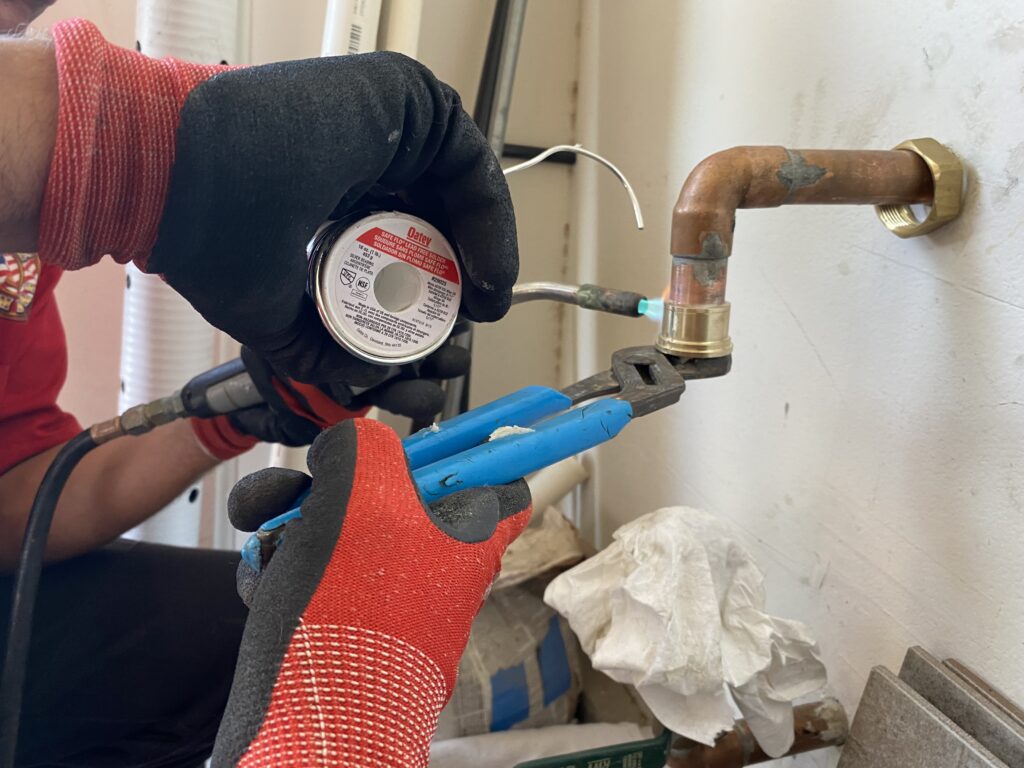
Sounds And Visual Clues That Point To A Gas Leak In Your Home
Sound is the second reliable indicator of a gas leak in your home, and it often shows up when the smell does not. Pressurized gas escaping through a small opening creates a hiss, a whistle, or a faint roar depending on the size of the breach and the pressure behind it. Turn off the television, the fans, and the air conditioner, then stand near your water heater, furnace, range, dryer connection, and pool heater and simply listen. A steady hiss from a fitting that should be silent is a serious finding. Larger leaks in underground service lines can produce a sound more like rushing air, sometimes audible from several feet away. Bubbling or gurgling from standing water in your yard after a storm is another sound worth investigating, since gas escaping from a buried line will percolate up through any moisture above it. Sound tells you a leak is active right now, not weeks ago. Follow the noise to its loudest point, then step back and stop.
Visual clues take a little more knowledge to interpret, but they are extremely useful on desert properties with buried lines. Grass, shrubs, or ground cover that dies in a narrow strip while everything around it stays healthy is a classic sign of gas escaping beneath the surface and displacing oxygen at the root zone. Dirt or dust blowing up from a spot in the ground with no wind to explain it deserves immediate attention. Puddles, pool water, or irrigation runoff that bubbles continuously without a source is another strong indicator. Inside the house, look at the flames on your gas appliances, since a healthy burner produces a crisp blue flame with a small inner cone. Flames that burn yellow, orange, or lazy indicate incomplete combustion, which points to a supply, venting, or airflow problem and raises the risk of carbon monoxide. Soot marks, scorching, or yellow staining around a burner or vent are warning flags you should never paint over. Pilot lights that repeatedly blow out for no clear reason belong on the same list.
Your gas bill is the slowest but most underrated clue, and it catches leaks that nothing else does. A steady climb in usage across two or three billing cycles, with no change in habits, appliances, or weather, means gas is going somewhere it is not being burned. Summer bills should be relatively flat in a home where the heater sits idle, so a July spike stands out clearly. Compare your usage against the same month in previous years rather than against last month, since seasonal swings can hide the trend. Small leaks waste fuel around the clock, and they tend to grow rather than seal themselves. Combine a rising bill with even a faint odor and you have enough evidence to act. Utilities publish usage history online, which makes this check easy to run in a few minutes. Anything that looks abnormal deserves a professional inspection of your gas piping.
Physical Symptoms That Signal A Gas Leak In Your Home
The people in your house can be the detector, and their symptoms are worth taking seriously. Natural gas and propane displace oxygen in an enclosed room, and reduced oxygen produces headache, dizziness, fatigue, nausea, and a general feeling of being unwell. Many homeowners chalk these symptoms up to summer heat, dehydration, or a virus, especially in a climate where triple digit afternoons are normal. The telling pattern is timing and location: symptoms that appear at home and fade within an hour or two of leaving are a major red flag. Pay close attention if more than one person in the household reports the same thing on the same days. Pets often show it first, since they are smaller and frequently spend time closer to the floor. A dog that seems lethargic, disoriented, or reluctant to enter a certain room may be telling you something. Trust that pattern rather than explaining it away.
Carbon monoxide is a separate hazard that often travels alongside gas appliance problems, and confusing the two costs lives. Carbon monoxide is produced by incomplete combustion in a gas burner, not by raw fuel escaping a pipe, and it has no smell, no color, and no taste whatsoever. Its symptoms overlap heavily with a gas leak, including headache, confusion, weakness, and nausea, but carbon monoxide is far more likely to render someone unconscious before they understand what is happening. Every home with any gas appliance needs working carbon monoxide alarms on every level and near sleeping areas. Those alarms will not detect a raw natural gas or propane leak, which is a distinction most homeowners do not know. Combination alarms that detect both explosive gas and carbon monoxide exist and are worth the small investment. Replace alarms according to the manufacturer date stamped on the housing, since sensors degrade over time. Test them at the start of every season.
Certain groups feel the effects sooner and more severely, which changes how quickly you should react. Infants, young children, older adults, pregnant women, and anyone with heart or lung conditions have far less tolerance for oxygen displacement. If a vulnerable person in your household reports symptoms and you also notice any odor, sound, or appliance irregularity, evacuate immediately and call for help from outside. Do not spend time trying to confirm your suspicion while people are still inside the building. Fresh air resolves mild exposure quickly, but medical evaluation is appropriate for anyone who lost consciousness, vomited, or remained confused after getting outside. Tell emergency responders and medical staff that gas exposure is suspected, since that information changes their treatment approach. Err heavily toward caution here. No amount of inconvenience outweighs the risk.
How To Test For A Gas Leak In Your Home Safely
There is a narrow set of things a homeowner can safely do to confirm a suspected gas leak, and a much longer list of things that make the situation worse. The dividing line is simple: you may look, listen, and use non sparking methods on accessible fittings, and you must never introduce heat, flame, or electrical activity. Every test described here assumes you smell only a faint odor, the house is ventilated, and no one is experiencing symptoms. A strong odor, an audible hiss, or any symptoms means you skip testing entirely and evacuate. Homeowner testing is a way to confirm a suspicion before calling, not a substitute for a licensed inspection. Gas piping is regulated for a reason, and California code requires licensed work on fuel lines. Use these methods to gather information, then hand the problem to someone with the tools and the credentials to fix it correctly.
The Soapy Water Method To Test For A Gas Leak In Your Home
The soapy water test is the oldest and safest way for a homeowner to confirm a gas leak in your home at an accessible fitting. Mix roughly one part liquid dish soap with three parts water in a spray bottle or a small cup, stirring gently so you get solution rather than foam. Apply it generously with a brush or a light spray across the threaded joints, the flex connector ends, the shutoff valve body, and the union at each appliance. Watch for at least thirty seconds, because a slow leak may take time to build a visible bubble. Escaping gas pushes through the soap film and creates a growing cluster of small bubbles or a single expanding dome. A leak large enough to blow the solution off the fitting entirely will be obvious immediately. Mark any spot that bubbles with a piece of tape so you can point it out later. Wipe the solution off afterward, since soap left on brass and steel can contribute to corrosion over time.
Technique matters more than most people assume, and a sloppy test produces false results in both directions. Work in daylight or with a battery powered flashlight held by someone else, never a lighter, a match, or a candle. Do not turn a light switch on or off while you are working near a suspected leak, since the small arc inside a switch is a legitimate ignition source. Avoid the temptation to spray a large area at once, because bubbles from your own application will confuse the reading. Test one fitting at a time, moving methodically from the shutoff valve toward the appliance. Remember that the soapy water test only works on connections you can see and reach, which excludes buried lines, piping inside walls, and anything under a slab. Roughly half of the leaks found on residential systems are in places a homeowner can never inspect. That limitation is exactly why instrument testing exists.
Know what to do the moment you find a bubbling fitting, because the next few minutes matter. Shut off the gas supply at the appliance shutoff valve if you can reach it safely, turning the handle so it sits perpendicular to the pipe. If the leak is upstream of the appliance valve or you cannot identify the source, shut off gas at the main using a wrench on the meter valve or close the valve at your propane tank. Open windows and doors, leave the building, and call from outside. Do not attempt to tighten the fitting yourself with a wrench, since overtightening cracks fittings and a joint that loosened once has usually failed its sealant. Never apply tape, putty, epoxy, or a clamp to a gas line as a temporary fix. A leaking joint needs to be taken apart, cleaned, resealed with an approved gas rated compound, and pressure tested. Found a leaking fitting or a failing connector? Click here for our gas line repair service.
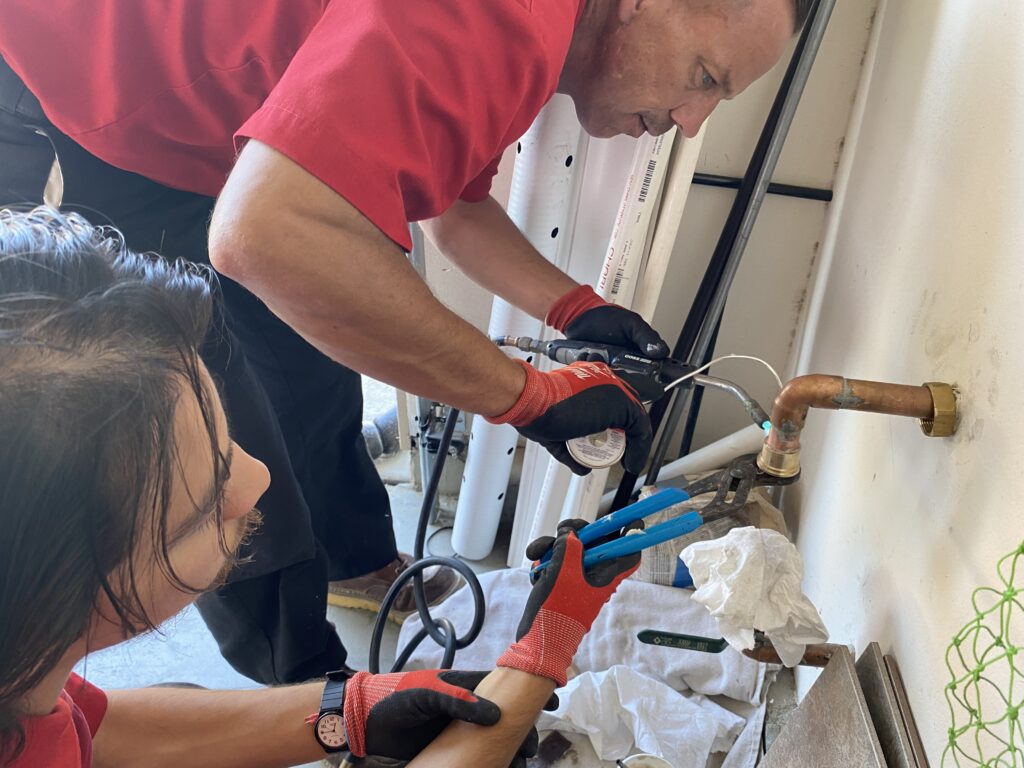
Using A Gas Detector To Find A Gas Leak In Your Home
A combustible gas detector removes guesswork from finding a gas leak in your home, and consumer models are affordable and widely available. Handheld units use a sensor that responds to methane, propane, and other combustible gases, giving you an audible tone and a numeric or bar graph reading. The better ones let you adjust sensitivity, which matters because a high sensitivity setting will alarm on the trace gas present near almost any appliance. Turn the unit on in clean outdoor air so it calibrates to a normal baseline before you carry it inside. Move the probe slowly, roughly one inch per second, along the length of every accessible gas line and around every fitting. Speed is the most common user error, since a quick sweep passes through a small plume before the sensor can respond. Sweep high for natural gas and low for propane, following the physics of each fuel. Consistent alarms at the same spot on repeated passes indicate a genuine leak.
Fixed detectors add continuous protection and are worth installing in specific locations around the property. Mount natural gas detectors near the ceiling in the utility room, the kitchen, and any space with a gas appliance, keeping them a few feet away from the burner itself to avoid nuisance alarms. Propane detectors belong low on the wall, generally within a foot of the floor, because propane pools downward. Garages, crawl spaces, and enclosed water heater closets are high value locations in most High Desert homes. Follow the manufacturer instructions for placement, since dead air corners and direct airflow from a vent both degrade performance. Test the units monthly using the test button and replace them at the interval printed on the label, typically every five to ten years. These devices are inexpensive insurance for a hazard that gives limited warning. They do not replace an inspection, but they buy you time.
Professional detection equipment operates on a different level, and understanding the gap explains why a service call finds what your handheld missed. Licensed plumbers use calibrated combustible gas indicators that read in parts per million and can trace a leak to a specific location rather than a general area. For buried and concealed lines, technicians run a pressure test by isolating a section of piping, pressurizing it with air, and watching a gauge for any drop over a set period. California code generally requires fuel gas piping to hold at least ten pounds of pressure for a minimum of fifteen minutes, and many local jurisdictions require longer or higher. A pressure test is definitive in a way that sniffing never is, because a line that holds pressure has no leak anywhere along its length. Technicians also use tracer gas, electronic listening equipment, and inspection cameras for lines under slabs and in walls. That combination locates the exact failure point with minimal demolition. It also produces documentation your utility or inspector may require before service is restored.
What To Do Right After You Confirm A Gas Leak In Your Home
The moment you confirm a gas leak in your home, your priority shifts from investigation to evacuation. Get every person and every pet out of the building immediately and move well away from the structure, ideally across the street or at least one hundred feet from the house. Leave the doors open behind you if you can do it without delay, since ventilation reduces the concentration inside. Do not go back for laptops, wallets, or anything else. Take the shortest path out and keep everyone together so you can account for the whole household. If a neighbor shares a wall or sits very close by, warn them from outside. Speed here is worth far more than thoroughness. Gas concentrations can change quickly in an enclosed space.
What you avoid touching on the way out is just as important as how fast you move. Do not flip any light switch, do not press a garage door opener, and do not unplug or plug in anything, since each of those actions can produce a spark. Leave your phone in your pocket until you are well outside and upwind, because cell phones and cordless handsets are ignition sources in a saturated environment. Never start a vehicle parked in an attached garage, and do not use a doorbell to alert anyone. Do not light a candle, a cigarette, a grill, or a flashlight with a mechanical switch near the suspected area. Do not attempt to locate the leak with a flame under any circumstances, an old practice that still injures people every year. Leave ceiling fans and the air conditioner exactly as they are rather than turning them on or off. Every one of these rules exists because someone learned it the hard way.
Once you are outside and safe, make your calls in the right order and stay put. Call 911 first for a strong odor, an audible leak, or any symptoms, then call your gas utility or propane supplier, both of which respond to leak reports around the clock at no charge. Give them your address, describe what you smelled or heard, and tell them how many people were inside. Wait outside until a responder tells you the building is safe to enter, no matter how long that takes. The utility will make the immediate hazard safe and shut off service, but they generally stop at the meter and will not repair piping inside your home. That repair, the pressure test, and the permit work belong to a licensed plumbing contractor. Line up that call while you are waiting so the repair can start as soon as the area is cleared. Getting your service restored quickly depends on having the right professional ready.
Why You Need A Licensed Plumber For Gas Leak Detection And Repair
Gas work is one of the few areas of home maintenance where the do it yourself route is genuinely indefensible. The consequences of a mistake are fire, explosion, carbon monoxide exposure, and voided insurance coverage. California requires licensed contractors for fuel gas piping, and most jurisdictions in San Bernardino County require permits and inspection on repairs and replacements. A licensed plumber brings calibrated instruments, code knowledge, proper materials, and the ability to pressure test the finished work. Just as important, a professional finds the leaks your inspection could never reach, including buried service lines, piping under slabs, and connections inside walls. Rescue Plumbers Inc has handled gas line work across the High Desert for fifteen years, and we do it with the documentation your insurer and your inspector expect.
What A Professional Gas Leak Detection Visit Includes
A professional gas leak detection visit starts with a conversation about what you noticed and when, since your observations narrow the search significantly. The technician then surveys every gas appliance in the home, checking flame quality, venting, combustion air, connector condition, and the presence of required sediment traps. A calibrated combustible gas indicator sweeps the full run of accessible piping, fitting by fitting, at a pace slow enough for the sensor to respond accurately. Suspect areas get confirmed with a secondary method so you are not paying to chase a false reading. For anything concealed or buried, the technician isolates the section and runs a pressure test with a gauge to prove the line either holds or fails. That combination gives a clear answer about where the problem is and how far it extends. You get the findings explained in plain terms along with your repair options.
The inspection also catches the conditions that cause the next leak, which is where most of the value sits. Flexible appliance connectors have a service life and should be replaced any time an appliance is pulled out and reinstalled, since bending a used connector work hardens the metal. Uncoated brass connectors manufactured before the mid nineteen seventies were recalled and still turn up in older High Desert homes. Corrugated stainless steel tubing requires proper bonding to reduce lightning related damage, a real concern during monsoon season out here. Buried steel lines corrode in alkaline desert soil, especially where coating was scraped during installation or where irrigation keeps a section damp. Shutoff valves seize when they are never exercised, leaving you unable to isolate an appliance in an emergency. Every one of these gets documented during a thorough visit.
Timing your inspection around your summer usage makes the visit more useful. Pool heaters, outdoor kitchens, fire pits, and patio heaters all sit on lines that spend part of the year idle and exposed to weather, dust, and sun. Water heaters work continuously through summer in a garage that may hit well over one hundred degrees, and that heat is hard on connectors and control valves. Homeowners who travel in July and August should have their system checked before leaving, since a leak in an empty house has nobody to smell it. Adding a new gas appliance is another natural trigger, because the new line needs to be sized, permitted, tested, and inspected. Planning a new gas appliance or an outdoor kitchen? Click here for our gas line installation service.

Gas Line Repair And Replacement After A Gas Leak Is Found
Once the leak is located, the repair depends on what failed and how much of the system is affected. A single leaking joint on otherwise sound piping usually gets disassembled, cleaned, resealed with an approved gas rated compound or tape, reassembled to spec, and pressure tested. A corroded section of buried line typically needs replacement rather than patching, because corrosion that produced one pinhole rarely stopped at one spot. Failed flex connectors get replaced with new listed connectors sized for the appliance. Where a run inside a wall or under a slab has failed, rerouting through an accessible path is often faster and cheaper than opening concrete. Your plumber should walk you through the options with real costs attached rather than presenting a single take it or leave it number.
Full repiping of a gas system comes up more often than homeowners expect, particularly in houses built before the nineteen eighties. Older galvanized and black iron systems accumulate scale and rust internally, restricting flow and creating weak points at every threaded joint. Homes that have added appliances over the decades frequently run undersized piping that starves a new water heater or range of the volume it needs. Replacing the system with correctly sized piping fixes both the safety problem and the performance complaints at the same time. Materials, routing, and support all follow code requirements that an unlicensed handyman is unlikely to know. Permits and inspection are part of doing it right, and they protect your insurance coverage in the event of a future claim.
Every repair we perform ends with a documented pressure test before gas is restored, without exception. That test proves the section holds and gives you something concrete to show a utility, an inspector, or an insurance adjuster. We also verify appliance operation afterward, checking flame quality and venting so you are not left with a new problem in place of the old one. Any additional concerns we spotted during the work get written down and explained rather than quietly upsold. You decide what gets addressed now and what waits. That approach is why our customers in Phelan, Hesperia, Apple Valley, and Victorville call us back.
Why Choose Rescue Plumbers Inc For Gas Leak Detection In The High Desert
Rescue Plumbers Inc is family owned and operated out of Phelan, and we have served the High Desert for fifteen years. Our technicians are not paid on commission, which means nobody has a financial reason to talk you into a repiping job when a single fitting needs attention. You get an honest assessment of what we found, what it will cost, and what happens if you wait. Estimates are free and carry no obligation. We answer the phone ourselves and speak to you like a neighbor, because in most cases that is exactly what you are. Licensed and insured work, done right the first time, is the whole business model.
Local knowledge changes the quality of the diagnosis in ways that matter. We know how alkaline desert soil attacks buried steel, how monsoon runoff exposes shallow lines, and how a garage water heater behaves after a week of one hundred five degree afternoons. We know which neighborhoods have propane and which have utility service, and we know the permit process in San Bernardino County. That experience shortens the search and reduces the amount of digging, cutting, and guessing involved. Crews that drive in from outside the area start every job at a disadvantage. We start with context.
If you suspect a gas leak in your home, get everyone outside, call the emergency line, then call us at (760) 241-3100 to handle the repair and the testing. We serve Phelan, Pinon Hills, Wrightwood, Oak Hills, Hesperia, Apple Valley, Victorville, Adelanto, Spring Valley Lake, Helendale, Oro Grande, Lucerne Valley, Barstow, and the surrounding High Desert communities. You can also reach us at fixit@rescueplumbersinc.com to schedule an inspection at your convenience. Gas problems do not improve on their own, and the cost of checking is a fraction of the cost of being wrong. Let us take a look and give you a straight answer.